Most families think they have one or two ways to pay for senior care. They usually have five or six. This page plots every source — savings, Social Security, pensions, long-term care insurance, VA benefits, home equity, reverse mortgage, home sale, Medicaid, family — against the care-cost timeline. It also names the gap most families don’t see coming: care costs start immediately, but the funding takes 30 to 180 days to arrive.
When the home stays: Modify and Fund. When the home goes: Sell and Fund.
Different families, different answers. The funding logic differs — and this page makes those differences explicit.
Care costs begin immediately and continue month after month. Funding sources don’t. Each one has its own approval timeline — and that gap is where the planning matters most.
Good planning = matching the funding timeline with the care timeline.
Funding sources organize by what they pay for and which path they serve. Not every source works for every situation.
If staying: pays for modifications (grab bars, ramps, walk-in showers, stair lifts, first-floor primary suite).
If selling: funds move costs or bridges until sale proceeds arrive.
If staying: pays for in-home care.
If selling: pays for facility or community care.
These do NOT pay for upfront modifications.
When the home goes, the equity becomes available. Three options, different timelines.
Care costs begin immediately. Most major funding sources take 30–180 days. That gap is real, and it works differently depending on your path:
If you’re staying home: The gap is funding both the upfront cost of modifications AND the monthly cost of in-home care. Bucket 1 covers modifications. Bucket 2 covers care. If you assume Bucket 2 covers modifications too, you’ll plan wrong.
If you’re selling: The gap is funding the move and the monthly cost of facility care while the home sells. A traditional sale takes 3–6 months. A direct cash purchase compresses that to 1–2 months. The difference can be tens of thousands of dollars in bridge costs.
A Home Equity Conversion Mortgage (HECM) is a powerful tool for the stay path. Before signing, ask:
1. Non-borrowing spouse: If your spouse isn’t on the loan, what protections exist if you pass first? The rules changed in 2015 but the protections have conditions.
2. Occupancy: The loan requires the home as primary residence. If you move to a care facility for more than 12 months, the loan may come due. What triggers that, and what’s the process?
3. Taxes and insurance: You still owe property taxes and homeowner’s insurance. Falling behind can trigger default. Is a set-aside account part of your loan structure?
4. Your heirs: When the loan comes due (usually at death or permanent move), your heirs can pay it off or sell the home. They won’t owe more than the home is worth. But they need to know this is coming.
Medicaid is not a funding option in the same way these are. It is a long-term care payor with strict rules. Before any decision involving the home and Medicaid — whether you stay or sell — consult an elder law attorney. The Medicaid protection page walks through the ten questions to bring to that meeting.
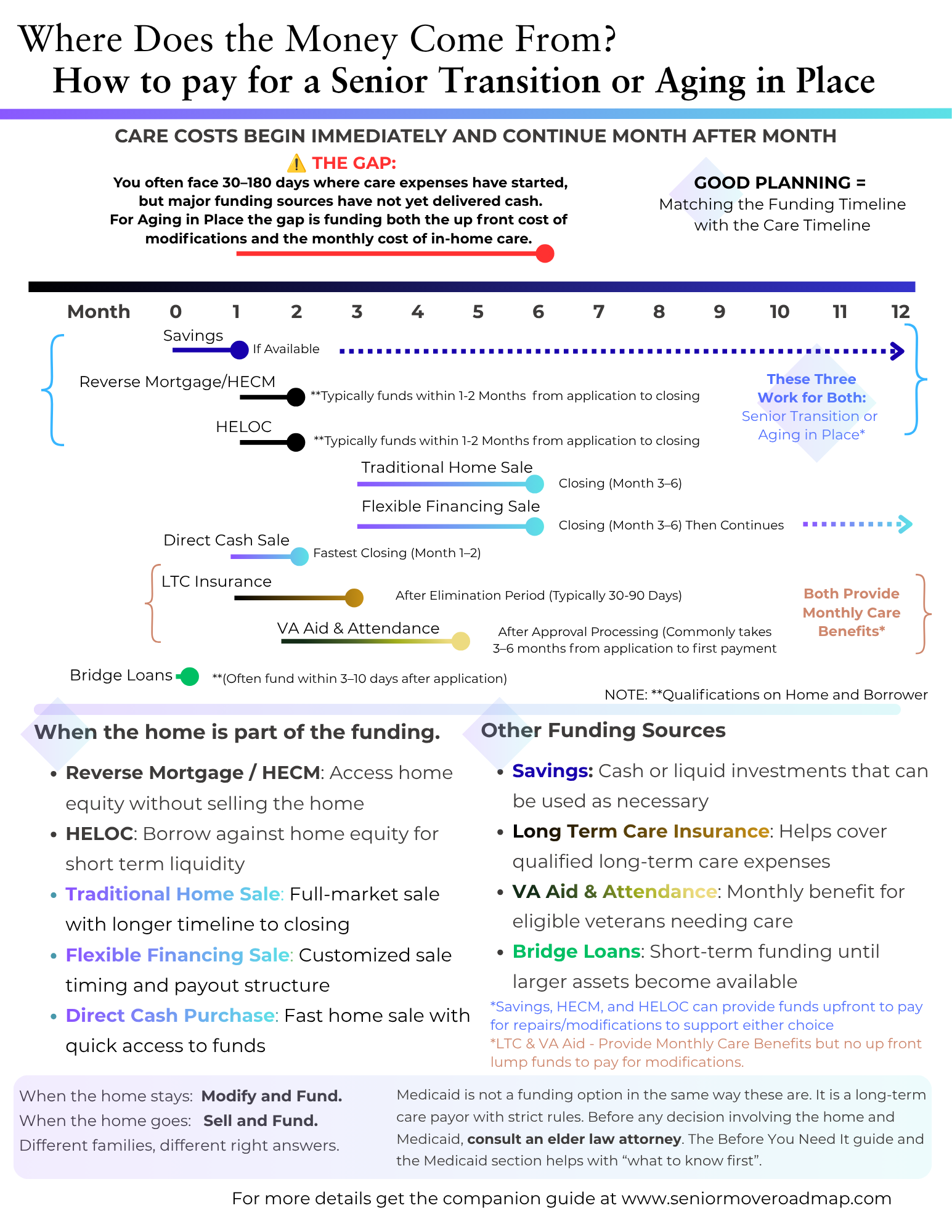
Every funding source plotted against the care-cost clock. The three buckets. The gap. The four reverse mortgage questions. Which sources work for staying, which work for selling, and which work for both.
Download Now — Free PDF · No email requiredIf your family is reading along.
The Senior Move Roadmap system was originally written to the adult child — the daughter, son, daughter-in-law, or family member helping you with this transition. If you’d like to read what they’re reading, or share this with them so you’re working from the same map:
This is informational guidance, not legal, medical, or financial advice. The right professional matters — and every section of this system tells you who that is.