Aging in Place

Most aging-in-place guides start with grab bars.
This one starts with two harder questions.

Should you? And how do you pay for it?

Download the Guide — Free Read the Decision Framework

Six questions before the first contractor call.

The Decision

When staying home is the right answer — and when it isn't. The framework competitors won't publish because it costs them leads.

The Math

What aging in place actually costs — compared to a community move. Year 1 looks one way. Year 3 and Year 5 look different.

The Funding

How families actually pay for $40K in modifications — reverse mortgage, HELOC, VA grants, bridge loans, and the options most families don't know about.

The Modifications

What to modify, in what order, and what it costs. Three tiers — Safety first, then Access, then Anticipation. Most families do it backwards.

The Professionals

Who to call, in what sequence. Plan first, build second — the clinical track and the financial track run in parallel, not series.

The Honest Limits

Five patterns that signal the aging-in-place chapter may be ending. Knowing them in advance changes what you build — and what you don't.

When staying home is the right answer — and when it isn't.

Every guide that sells home care, modifications, or senior living placement leads with the reasons to stay. This one doesn't. The decision belongs to the family — not to the business model of whoever published the guide.

When Aging in Place IS likely the right answer

  • ✓  Cognitive function is solid
  • ✓  Strong social connection in the home environment
  • ✓  Home can be modified without structural limitations
  • ✓  Family or paid care can cover gaps in ADLs
  • ✓  Senior genuinely wants to be there — not just resisting change
  • ✓  Funding for modifications is available or accessible
  • ✓  Medical needs are stable, not escalating

When Aging in Place is likely NOT the right answer

  • ✗  Cognitive decline is progressing — memory, judgment, safety
  • ✗  Isolation is a significant factor
  • ✗  Multiple falls or near-misses in the past year
  • ✗  Medical needs require care that can't be reliably provided at home
  • ✗  Caregiver is burning out — this is a real limit, not a moral failure
  • ✗  The cost math has already flipped (see below)
  • ✗  The home itself cannot be made safe at a reasonable cost

"The right column is the one nobody publishes. Every competitor leads with the left column because the publishers sell home care or modifications. The right column is the honest service."

Three tiers. Do them in this order.

Most families install smart speakers before fixing the bathroom. Tier 1 is what keeps your parent alive. Tier 2 is what keeps them in the home as their needs grow. Tier 3 is the layer of comfort and connection. Do them in that order — not the reverse.
Aging in Place modification tiers: Tier 1 Safety (bathroom grab bars, walk-in shower, motion lighting, stair handrails), Tier 2 Access (zero-threshold entry, widened doorways, lever handles), Tier 3 Anticipation (smart home, fall detection, cameras)

Tier 1 — Safety. Do this first. Do it now.

Bathroom grab bars, walk-in shower, motion-activated lighting, stair handrails, throw rugs removed, smoke and carbon monoxide monitors. The bathroom is where most falls happen. Most of Tier 1 can be completed in a week for $5,000–$15,000.

Tier 2 — Access. For when needs grow.

Zero-threshold entry, widened doorways, lever handles throughout, first-floor primary suite. These modifications extend the window in which the home works as needs increase. Plan them early; they require more lead time and cost.

Tier 3 — Anticipation. Comfort and connection.

Smart home devices, fall detection technology, cameras and remote monitoring, emergency response systems. Layer these on top of a safe and accessible home — not instead of one.
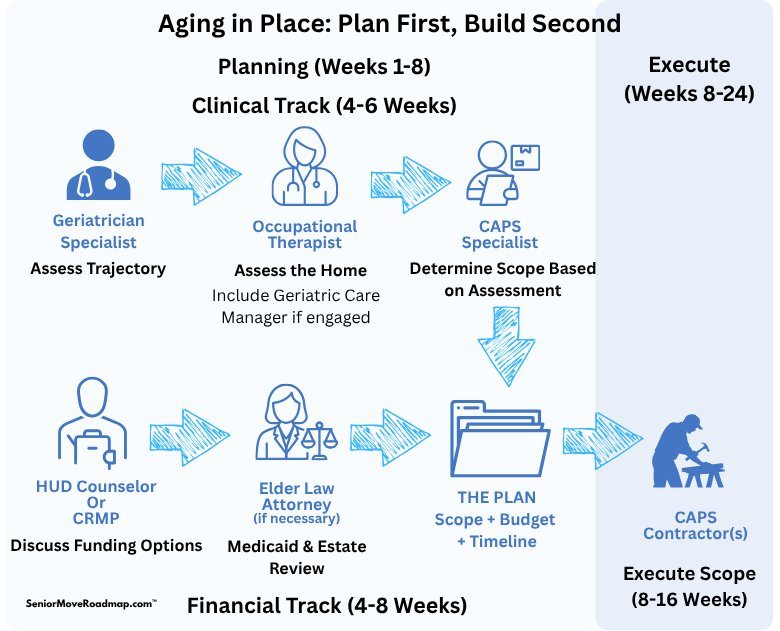
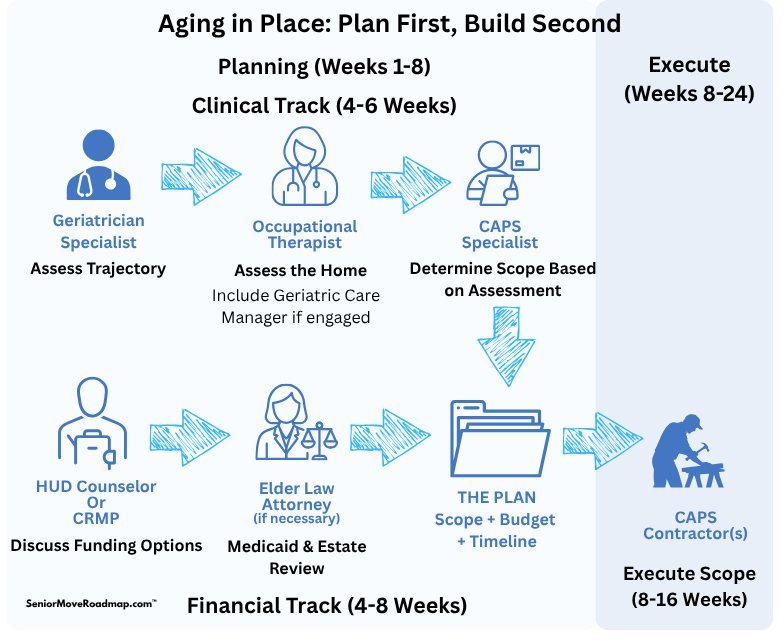
Plan first. Build second.

The most common mistake families make is calling a contractor first. The professional sequence matters — the clinical assessment should drive the modification scope, and the financial picture should be understood before anything is built.

Aging in Place planning process: Clinical Track (Geriatrician → Occupational Therapist → CAPS Specialist) and Financial Track (HUD Counselor/CRMP → Elder Law Attorney → The Plan) running in parallel before CAPS Contractor executes

Two tracks run in parallel — not in series. The clinical track (geriatrician, OT, CAPS specialist) defines the scope. The financial track (HUD counselor, elder law attorney) clears the funding. Both feed into the plan. Then the contractor builds. Doing it in any other order costs families money and often produces modifications that don't match actual needs.

Full Professional Guide — Who to Call →

Knowing when the chapter is ending.

This is the section most guides skip. The goal isn't to keep everyone at home at any cost — it's to help families make the right decision, whatever that turns out to be.

1. Cognitive decline is progressing. When judgment and safety awareness are genuinely impaired, the home environment — even a fully modified one — may not be a safe solution.

2. The caregiver is burning out. A family caregiver who is exhausted and overwhelmed is not a sustainable care plan. This is a real limit, not a moral failure.

3. Medical needs have exceeded what home care can provide. Some conditions require care that isn't safely or consistently deliverable in a home setting regardless of modifications.

4. Isolation has become a real factor. A person aging in place alone, with limited social connection, faces real risks that modifications cannot address.

5. The cost math has already flipped. By Year 3, aging in place with full home care often costs more than a senior living community. When the math has crossed, continuing to invest in the home may not make financial sense.

Recognizing the Signs

If these limits are starting to show, Step 1 of the guide system covers the signals that a transition may be approaching.

Step 1 — Recognize the Signs →

Finding the Right Community

If a senior living community is the next step, Step 5 covers every question to ask — with a 23-question tour guide and comparison tools.

Step 5 — Find the Right Community →

The aging-in-place deep dives

Each section of this guide has a dedicated page with the full detail — the numbers, the framework, the professional roster. Start with whichever one matches where you are right now.

The Decision
Should You Stay or Move?
The five questions and the honest two-column test most guides won’t write.
The Math
The 5-Year Cost Comparison
Year 1 looks cheaper. By Year 3 the math has flipped. See the numbers.
The Team
Who to Call and When
Plan First, Build Second — the right professional sequence, with costs.
The Full Guide

50 pages. The complete aging-in-place framework.

Decision framework, 5-year cost math, funding options, modification tiers, professional sequence, and the honest limits. Free to download.

Download — Free PDF · 50 pages · No email required
📍 Houston Families

A Houston-specific edition is available.

The Houston edition includes Texas-specific guidance — hurricane preparedness, heat emergency planning, Harris County resources, and the Houston real estate picture when the home is part of the funding.

Houston Aging in Place Edition →

This is informational guidance, not legal, medical, or financial advice. The right professional matters — and every section of this system tells you who that is.