Why the order matters more than the names
Most families build the team in the wrong order. They get a contractor's bathroom quote first, sometimes a second one, then maybe — if a friend mentions it — they hire an occupational therapist to "take a look" after the work is already specified. The financial piece comes last, usually when the contract is ready to sign and someone realizes how the money is actually going to flow.
This is the order that produces beautiful bathrooms that didn't solve the right problem, smart-tech installations that should have waited, modifications that meet code but don't fit the parent who'll actually use them, and funding decisions made under deadline pressure that lock the family into the wrong loan.
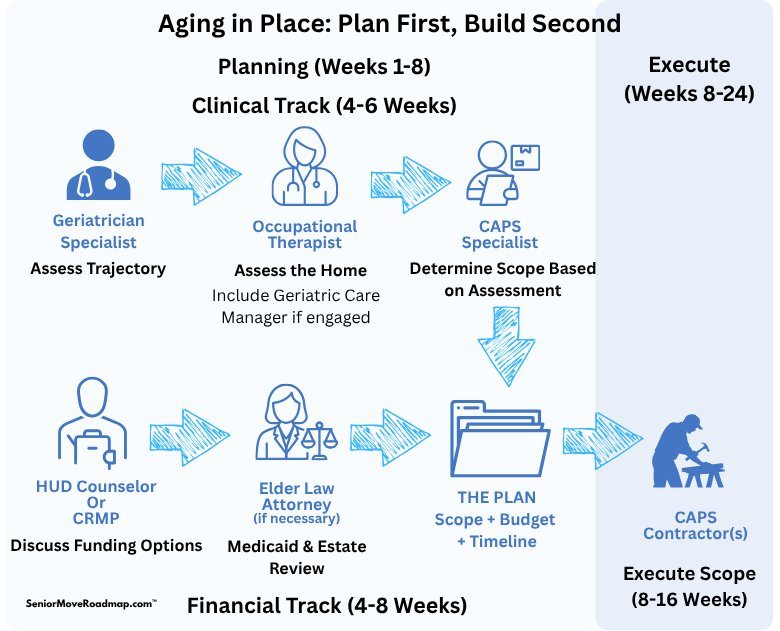
The right sequence runs two tracks in parallel — a clinical track and a financial track — and the contractor is the last technical voice in, not the first. The graphic below shows it.
Walking through the sequence
The number of professionals on the diagram can feel like an avalanche. You don't hire them all at once, and you don't need to manage them all yourself. Start with the doctor and the OT. The rest enter the picture only as the situation needs them. Every family in this position feels like they should already know who to call. Almost none of them do. That's not a failure on your part — it's just that no one prepares us for this.
Start with the doctor.
The parent's primary care physician or — better, when available — a geriatrician gives the family a trajectory, not just a snapshot. "She's stable for now" and "she's likely entering moderate-stage Parkinson's within 18 months" are different planning pictures, and the modifications that fit one don't fit the other. If the family is already working with a Geriatric Care Manager, the GCM often coordinates this step.
Then the OT walks the house.
An occupational therapist's home assessment is the single highest-value early dollar spent in this process — typically $200–$500 for a 60–90 minute visit and a written report. The OT watches the parent move through the house, identifies the actual risks (which are rarely what the family expects), and writes the recommendations that drive everything else. An OT looks at things a contractor doesn't: the height of the toilet relative to the parent's mobility, the reach distance from the bed to the bathroom, the lighting transition zones where the parent's eyes can't adjust fast enough, the spaces where a walker has to turn and can't.
The CAPS specialist translates the assessment into a scope.
Often the CAPS specialist is also the contractor; sometimes it's a separate planner who hands a written scope to a contractor for bidding. Either way, this is where the OT's recommendations become a construction plan with dimensions, materials, and a sequence. CAPS stands for Certified Aging-in-Place Specialist — a credential from the National Association of Home Builders that means the professional has been specifically trained on the design principles that matter for seniors.
The financial track runs in parallel from the start.
A HUD-approved housing counselor or a Certified Reverse Mortgage Professional should be engaged at the same time the OT is scheduled — not after the contractor's quote arrives. Funding shapes scope. A $40,000 budget supports a different plan than a $15,000 budget, and the family deserves to know which one they're working with before they fall in love with a specification. If Medicaid is anywhere in the picture (now or possibly within five years), an elder law attorney joins the financial track — that conversation precedes any equity decisions.
The contractor executes the plan — last.
A CAPS-certified contractor takes the scope, the budget, and the timing constraints, and builds. By the time the contractor is engaged, the family knows what they want, what it should cost, how they're paying for it, and what the result is supposed to do for the parent.
When the sequence runs in this order, the family rarely changes the scope mid-build, the budget rarely runs over by more than 10%, and the result actually fits the parent. When it runs backwards, every one of those almost always goes wrong.
The shortest version: doctor → OT → CAPS planner → funding conversation → elder law (if relevant) → contractor. Most families do the opposite. Reversing the order is the single highest-leverage decision in the whole project.
The professional roster, one at a time
Below is each professional in the sequence, with what they do, what they don't do, and what it typically costs to engage them. You won't need every one of these — your situation determines that. But knowing the menu helps you call the right number first.
| Professional | What they do | What they don't do | Typical cost |
|---|---|---|---|
| Geriatrician (or PCP with senior focus) |
Reviews medical history, assesses cognitive and physical trajectory, identifies underlying conditions that change planning. Gives the family a multi-year picture, not just a snapshot. | Doesn't design the home. Doesn't quote the work. Doesn't manage care day-to-day. | Covered by Medicare for routine visits |
| Geriatric Care Manager (GCM) |
Coordinates the medical, care, and planning team. Walks the family through decisions. Often the single most useful hire when the family lives out of town. Look for an Aging Life Care Association member. | Doesn't replace the doctor, OT, or attorney — they assemble and quarterback the team. | $150–$250/hr or monthly retainer |
| Occupational Therapist (OT — home assessment) |
Walks the home with the parent. Identifies the actual safety and access risks. Writes a report that drives the modification scope. Highest-leverage early dollar in the whole project. | Doesn't design the construction. Doesn't supply contractors. Doesn't handle ongoing care. | $200–$500 one-time |
| CAPS Specialist (Certified Aging-in-Place Specialist) |
Translates the OT report into a written construction scope — dimensions, materials, sequence. Sometimes also the contractor; sometimes a separate planner who hands the scope to a contractor for bidding. | Doesn't do medical assessment. Doesn't handle funding. Doesn't make the stay-or-move decision for you. | $1,500–$5,000 planning fee, or folded into contractor scope |
| HUD-Approved Housing Counselor | Walks the family through reverse mortgage / HECM options honestly, without commission pressure. Required before any HECM application. | Doesn't originate the loan. Doesn't sell products. Doesn't give legal or tax advice. | $0–$200 (often free) |
| Certified Reverse Mortgage Professional (CRMP) |
Originates and structures a HECM when it's the right tool. Walks the family through the four traps (non-borrowing spouse, occupancy, taxes-and-insurance, heirs) honestly. Look for the CRMP credential — it's a higher bar than a generic reverse mortgage license. | Doesn't decide whether the HECM is the right tool — that should be a conversation with the HUD counselor first. | Paid through loan; no out-of-pocket fee for consultation |
| Elder Law Attorney | Handles Medicaid planning, estate documents, asset protection, and any transfer involving the home when Medicaid is in the picture (now or within five years). Essential before any gift, transfer, or below-market sale. | Doesn't manage investments. Doesn't price modifications. Doesn't replace the financial planner. | $300–$500/hr or flat fee for planning package |
| CAPS Contractor | Executes the scope. Does the build. Manages subs, permits, inspections. By the time they're engaged, they have a clear scope, a known budget, and a timeline that fits the family's constraints. | Doesn't design the plan from scratch. Doesn't make the stay-or-move decision. Shouldn't be the first call. | Per scope — typical aging-in-place build $20K–$80K |
Costs are national medians; your market will vary. The order matters more than the cost. A $400 OT assessment that prevents a $14,000 bathroom rebuild is the best return on capital in this whole sequence.
A note on credentials, honestly
The senior care world has a lot of credentials, and the credentials matter — but they aren't a substitute for fit. A CAPS contractor with the credential but no senior-specific portfolio is not the same as a CAPS contractor who's done forty of these projects. A CRMP who pushes for the loan in the first conversation is not the same as one who walks you through the four traps before talking products.
Use the credentials as a filter, not a verdict. Then talk to the human. The right professional for an aging-in-place project understands that the goal isn't the build — it's the parent's next chapter, lived safely, in the home they want to be in.
Houston, Texas families
If you're navigating this in the Houston market specifically, the guides tell you exactly which professional to call and what credentials to look for. When the home is part of the picture, Help with the Home connects Houston-area families with a real estate specialist who understands senior transitions.